Table of contents
- 1 What Makes Namibia such a Good Country to Visit?
- 2 Where are Good Places to go in Namibia?
- 3 Where are Good Places to Stay in Namibia?
- 4 When is the Best Time to Visit Namibia?
- 5 Is Namibia Good for Safaris?
- 6 How Many Days do you Need in Namibia?
Enhance your reading experience—immerse yourself in the adventure with our audio version. Click play and let the sounds of Africa captivate you!
Namibia is one of the very last places on earth that can leave you feeling as though you are taking a timid step into the unknown.
Home to a tiny population of just over 2 million people, spread out across the 824 292 km² of desert, dunes, scrubland, canyon, bushveld and desolate coast that make up the country’s varied and fascinating ecosystems, when you visit Namibia, it is easy to get lost in a sense of wonder.
Namibia is unlike any other place you’ll visit.
It has busy towns and a bustling city, where you can indulge in the finest foods, explore cultures and learn about the nation’s art scene, and where you’ll stay in some of the most luxurious accommodations.
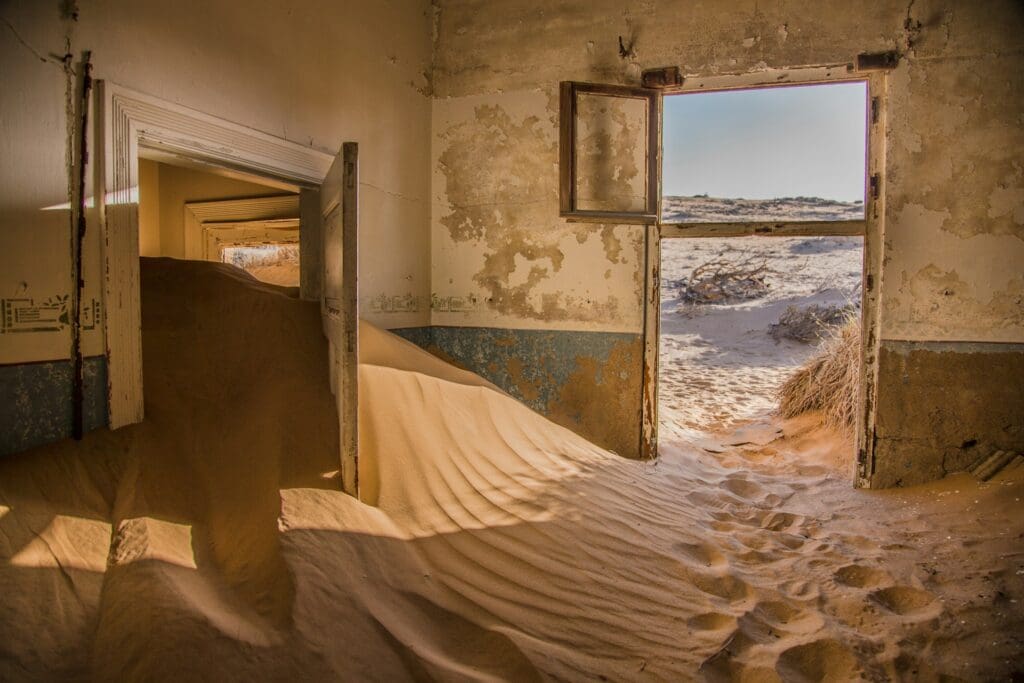
And then it has natural attractions, like the Namib and Sossusvlei, abandoned ghost towns, like Kolmanskop, and wide open spaces that go on forever, making it just the place for a road trip.
Namibia is for the explorer, for the traveller who wants to experience a place that is unique in every sense of the word.
And when you visit Namibia, we promise, your holiday will be one that leaves you changed, in the best ways, for the rest of your life.
What Makes Namibia such a Good Country to Visit?
When you visit Namibia, you’ll learn that what makes it a good country to visit is that it has so many naturally beautiful attractions to experience.
Unlike other African nations, Namibia seemingly has it all.
You can go on safari in Etosha National Park, and you can try your hand at dune surfing outside of Swakopmund.
You can hike through the mountains around the Fish River Canyon, and you can see waterfalls up north, in Kunene.
Not only that, but you can try craft beers and gourmet food in Windhoek, and you can stay in absolute luxury, at any one of the luxury desert lodges.
It also helps that Namibia is sparsely populated, politically stable in 2026, and exceptionally well managed for tourism.
Roads are good, the conservation policies are progressive, and the various exclusive concessions allow guests to have the most intimate access to wildlife and wilderness.
When you visit Namibia, you are not jostling for a view or fighting for a spot in a restaurant. You are given room to breathe, to reflect on your experience and to truly absorb a place that feels elemental and refined, in equal measure.
Where are Good Places to go in Namibia?
Namibia tourist attractions include some of the most beautiful landscapes and natural attractions. While the towns, like Swakopmund, are certainly worth spending a few days in, the real draw is the natural wonders, of which Namibia has plenty.
Some of the good places to go when you visit Namibia include:
Sossusvlei and Deadvlei
Sossusvlei, deep within the Namib-Naukluft National Park, is one of the must-visit destinations for every traveller.
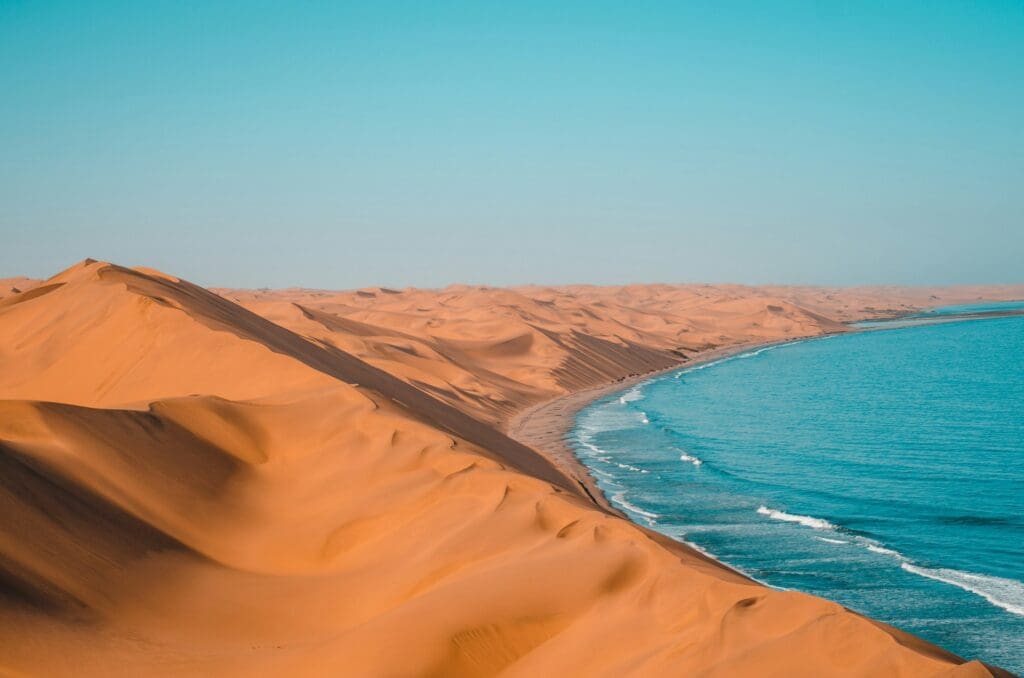
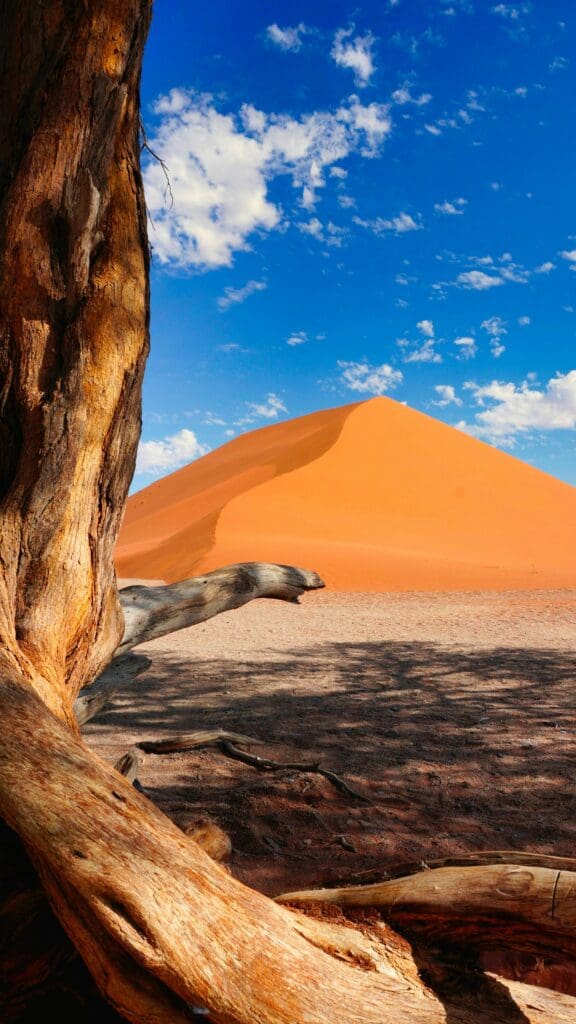
Sossusvlei is most famous for its almost mountainous dunes that change colour with the moving of the sun. The dunes famously catch the first light of the day in ways that turn the colours of the sand from deep crimson to soft gold, making them just the place to watch the sun rise.
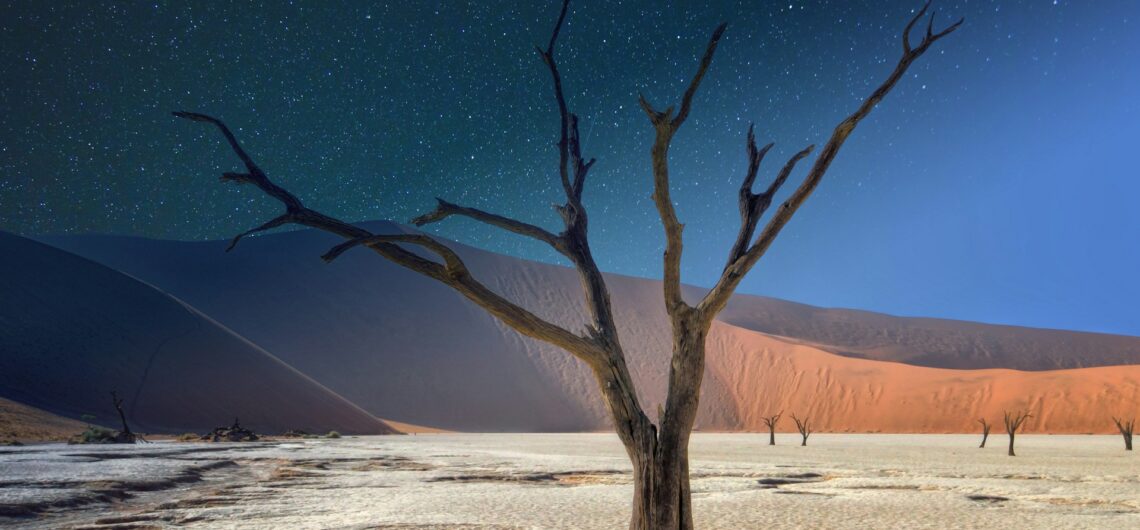
Nearby, is the Deadvlei and its cracked white clay pan and its centuries-old, dead and blackened camelthorn trees, frozen in time and silhouetted against the surrounding ochre sand.
Damaraland
Travelling north of Sossusvlei and you’ll arrive in Damaraland.
The area has a series of ochre-hued hills, a number of ancient valleys, and when walking through the region, you’ll be taken in by the profound sense of being someplace really remote and almost sacred.
Here, the desert-adapted elephants move silently, like spirits, along dry riverbeds, their presence all the more striking against the barren backdrop.
Damaraland is also home to the UNESCO-listed rock engravings at Twyfelfontein.
This ancient art depicts the area’s early human history, and consists of thousands of petroglyphs of animals and abstract forms carved millennia ago.
The Skeleton Coast
The Skeleton Coast is Namibia’s most haunting destination, an area that wouldn’t be out of place as the backdrop of a gothic romance novel.
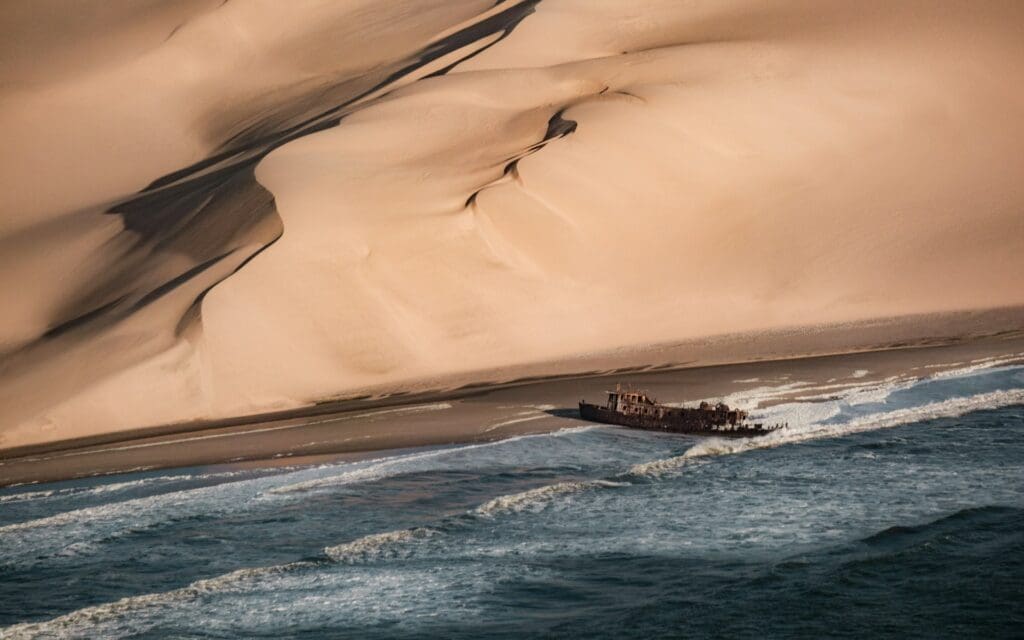
Along the coast, where the cold Atlantic meets the desert, you’ll see a fog-shrouded line of shipwrecks, seal colonies, and distant dunes.
Access to the area is somewhat restricted, making a trip something of a privilege, as most travellers will only ever see it by air.
Fish River Canyon
If you’re the kind of person who loves places that make you feel properly small (in the best way), head south to Fish River Canyon.
It’s the second-largest canyon on earth, and honestly, photos don’t do it justice. The river has spent millions of years slicing this huge, jagged wound into the earth, leaving behind sheer cliffs, folded rock layers in every shade of rust and ochre, and a sense of deep, ancient time hanging in the air.
Etosha National Park
For the quintessential safari experience, travellers generally head to Etosha National Park.
Covering over 22 000 km², Etosha is known for its shimmering water-filled salt pan which draws elephants, lions, giraffes, black rhinos, and countless other species to the waterholes, especially during the dry season when concentrations are highest.
Many waterholes are floodlit after dark, allowing for some of Africa’s best nocturnal sightings.
Where are Good Places to Stay in Namibia?
Luxury in Namibia is defined by understatement, seclusion, and location.
The good places to stay, when you visit Namibia, are the lodges set within private concessions or remote reserves, where you are one of only a handful of guests and where no experience is rushed.
In Sossusvlei, andBeyond Sossusvlei Desert Lodge will treat you to glass fronted suites that allow for stargazing from your bed, while Wilderness Kulala Desert Lodge will give you exclusive access to a private gate that will lead you into Sossusvlei.
Damaraland Camp, run in partnership with local communities, is another good place to stay and it will give you comfort along with luxury.
For those drawn to the coast, Shipwreck Lodge on the Skeleton Coast resembles the hulls of overturned boats, yet inside you find polished timber, curated interiors and attentive service.
Etosha’s Onguma The Fort has Moroccan inspired architecture and sits on the edge of the park, while Little Ongava sits within a private reserve known for rhino tracking on foot.
When you visit Namibia, you’ll soon see that each lodge included on your tour is chosen not simply for aesthetics, but for its guiding standards, conservation ethos and its ability to give you utter privacy throughout your stay.
When is the Best Time to Visit Namibia?
The best months to visit Namibia are generally from May to October.
These are the dry winter months, when wildlife congregates around waterholes and temperatures are mild during the day.
For safari in Etosha, this period of the year will give you exceptional visibility.
November to April brings warmer temperatures and sporadic rains.
The landscape turns greener, the birdlife flourishes, and you’ll be treated to some really dramatic skies. This period can be particularly rewarding if you plan to visit the Zambezi Region.
Luxury travellers planning to visit Namibia in 2026 should book well in advance, especially if you wish to travel during the peak months such as July and August.
Is Namibia Good for Safaris?
Namibia is an exceptional place for a safari but don’t expect the conventional experience, the kind that you would have in East Africa.
In Namibia, conservation is deeply ingrained with community conservancies, and this approach has helped wildlife numbers recover significantly since independence.
Desert adapted species, black rhino conservation in private reserves, and low density tourism models define the experience when you visit Namibia for a safari.
Etosha is the best safari destination if what you want is a classic game viewing experience, while private reserves such as Ongava allow guided walks and off-road tracking. In Damaraland, tracking elephants across arid terrain is a popular pastime.
To visit Namibia for safari is to prioritise quality over quantity.
Sightings are not rushed and the vehicles are fewer. Guides are highly trained and often deeply committed to the land.
How Many Days do you Need in Namibia?
Namibia is so much larger than many expect.
Distances between places are considerable, even with fly in connections.
A well paced luxury itinerary should typically take place over 10 to 14 days, so that you’ll have time to see Sossusvlei, Damaraland, Etosha and either the Skeleton Coast or Zambezi Region.
Shorter trips are possible, but they won’t usually give you time to really have an in-depth experience.
If you are ready to visit Namibia, our Namibia travel specialists can help put together a trip that’ll show you the very best of this ancient country.
Allow us to plan something exceptional for you.
Yes. Namibia remains one of Africa’s most stable countries politically and socially. Luxury lodges maintain high security and professional standards.
Visa requirements vary by nationality. Many European travellers receive visa on arrival access, though regulations should always be checked before departure in 2026.
Absolutely. Etosha’s open landscapes make wildlife viewing straightforward, and high quality lodges ensure comfort throughout.
Yes. Many itineraries link Namibia with Botswana or South Africa via regional flights, creating a broader southern Africa journey.
Yes. Its privacy, dramatic scenery and intimate lodges make it particularly appealing for couples seeking space and exclusivity.