Table of contents
- 1 What makes African safaris so special at night?
- 2 What are some animals that come out at night?
- 3 Do lions hunt at night?
- 4 Are honey badgers active at night?
- 5 Is it worth going on a night safari?
- 5.0.1 Are night safaris in Africa safe?
- 5.0.2 Can I book a night safari through my tour operator?
- 5.0.3 What should I bring with me on a night safari?
- 5.0.4 Why do rangers use red torches instead of white light during night drives?
- 5.0.5 Which nocturnal animals in Africa are most commonly seen on a night safari?
Enhance your reading experience—immerse yourself in the adventure with our audio version. Click play and let the sounds of Africa captivate you!
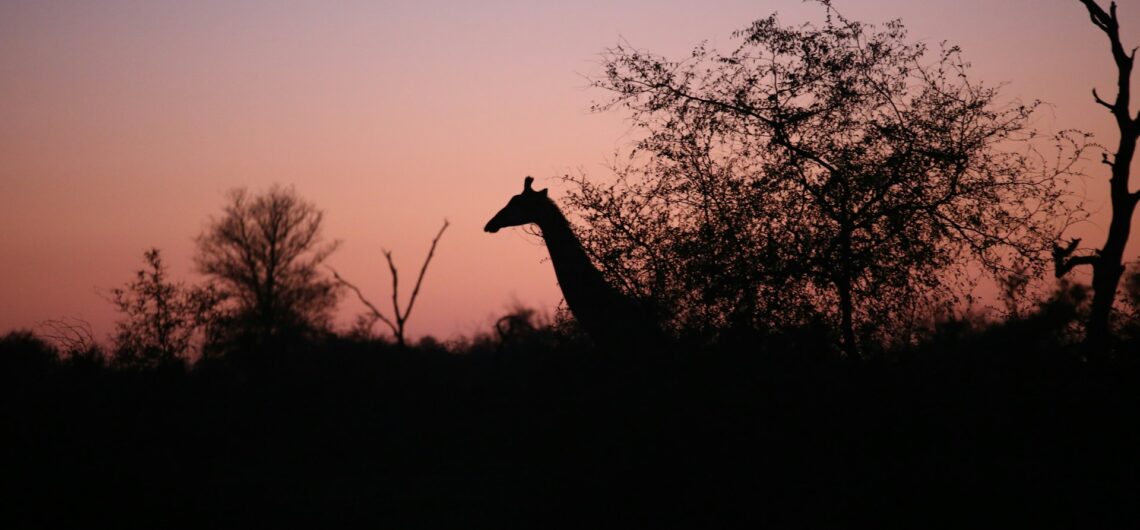
When the sun sinks low over the savannah and the heat finally cools off, a second world awakens.
For many travellers, the daytime drama of elephants grazing or giraffes gliding across the horizon is the main event of their African safari.
Yet those travellers who only go for a day trip are missing out on a whole different side to this most beautiful continent.
There is no quiet transition between day and night.
Once the usual wildlife disappear for the evening, settling into their safe spaces, in a burrow, huddle together, or under a tree, away from prying eyes and predators, a whole new variety of animals and birds come out.
Africa at night is something worth seeing, and as the nocturnal animals in Africa step out of the shadows, suddenly the landscape hums with new whispers, rustles, and piercing calls.
To experience this incredible, almost secretive, realm is to get a glimpse of the continent in an entirely new light, one reserved only for those willing to take a game drive into the darkness.
What makes African safaris so special at night?
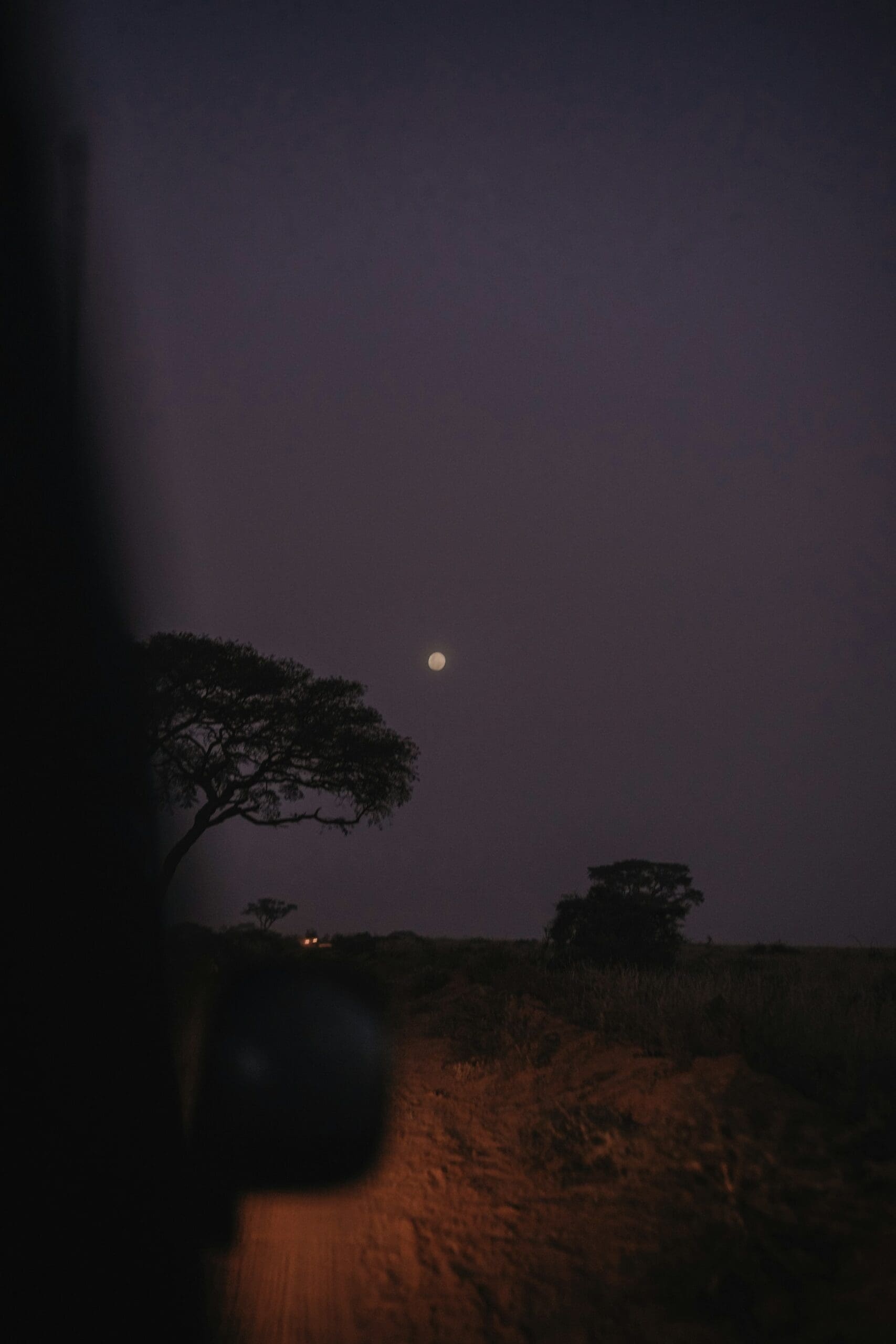
The darkness wraps itself around you, heightening your senses. A crackle in the grass feels closer, sharper. The air seems cooler, scented with wild sage and dust.
Unlike during the heat of the day, when animals rest and pant lazily beneath acacia trees, the nighttime belongs to predators and wanderers, and just as they are hyper vigilant, so are you.
What makes African safaris so special at night is that you get the unique opportunity to see animals that you wouldn’t see during the day.
Led by an experienced ranger, you’ll step into a world that feels mysterious and almost hidden from view. In the darkness, spotting wildlife on your own can be nearly impossible, which is why having a guide is invaluable. With the sweep of a red torch across the landscape, they will find the nocturnal creatures you might otherwise never notice.
The safari after dark is also the perfect opportunity to do some stargazing. Out there in the bush, you’ll be far away from the lights of hotels and campfires, making the skies so much clearer.
And finally, while it might not be everyone’s idea of an exciting sighting, night drives are when you are most likely to see predators on the hunt.
What are some animals that come out at night?
A night game drive will give you sightings of some of the most fascinating species, animals that travellers rarely, if ever, see in daylight.
Keeping in mind that some animals might be more commonly encountered than others, these are some of the nocturnal animals in Africa.
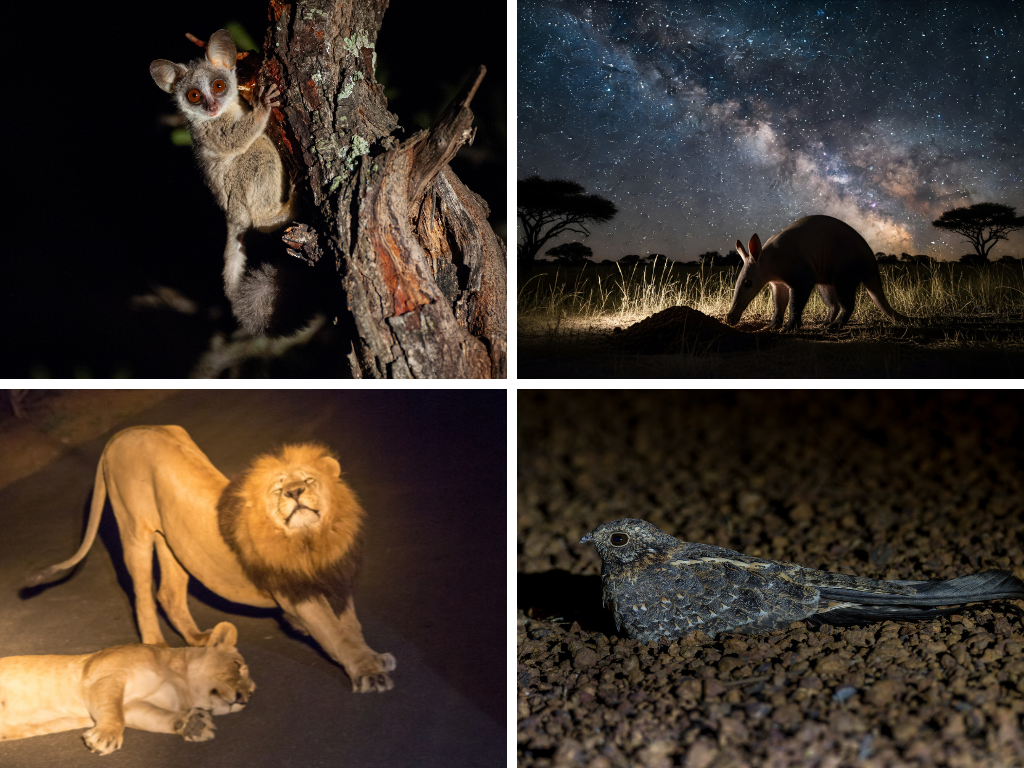
The aardvark, with its comically long snout and powerful claws, is a rare sighting, but if you are lucky enough to spot it trundling through sandy soils, sniffing out termites, it’s quite exciting! The aardvark is similar in appearance to a pig, and it can be rather shy.
The aardwolf, which, while similar in name to the aardvark, looks nothing like is closely related to the hyena. The aardwolf feeds mostly on termites and has a surprisingly gentle nature.
Bushbabies, wide-eyed and nimble, are a rather common sight, both in safari parks and in camps. They leap through branches, and with a cry that can send shivers down your spine, you’ll know when one is around.
Then there are civets, cat-like night creatures that move like shadows as they forage for fruit and insects. Similar in appearance to a cat with a face that resembles a raccoon, the African civet is not often seen. They are solitary animals, and their black and grey fur coats allow them to easily disappear.
Genets, which are often confused with civets, are also nocturnal animals in Africa. These graceful, spotted carnivores have long, banded tails and are mostly seen climbing trees at night.
Porcupines, whose quills rattle like warning drums when disturbed, are also one of Africa’s nocturnal animals. Cape porcupines are among the largest in the world, and they are hard to miss.
Springhares are another of the nocturnal animals in Africa that you can spot on a nighttime game drive. These animals, known locally as springhaas, are a little shabby-looking, but they are rather impressive in other ways. They can make huge leaps, and they use their long tails to keep themselves balanced.
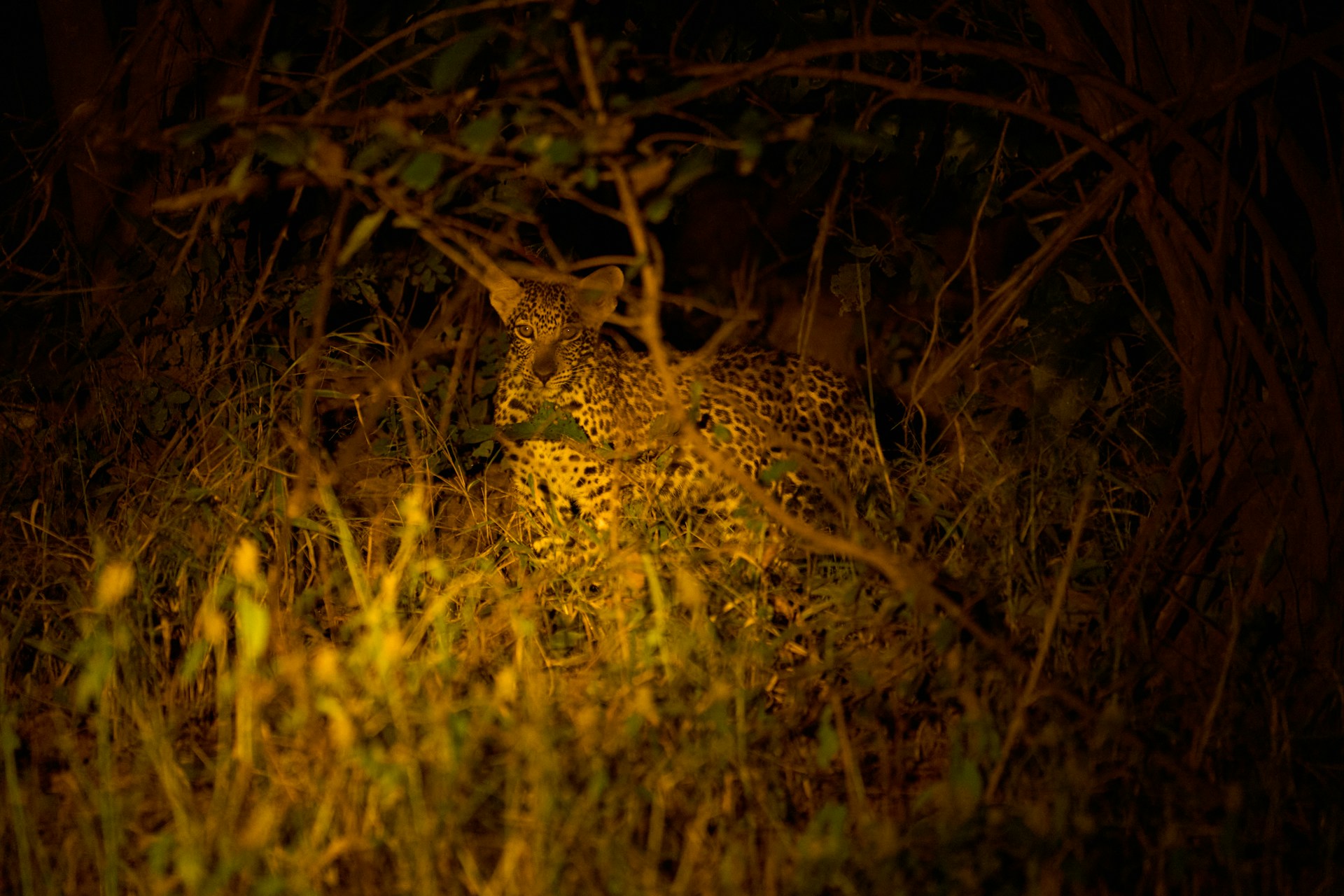
Night drives are also the ideal time to see predators like leopards and lions on the hunt, and if you are really lucky, you might catch sight of the fiercesome honey badger, an animal that has a bit of a legendary status in safari circles.
Perhaps most enchanting of all the critters and creatures you’ll see when on a night drive are the owls and nightjars, the winged hunters whose calls are the very soundtrack of Africa after dusk.
To see these nocturnal animals in Africa is to understand just how alive the continent becomes once darkness falls, and even though you might not see as many animals as you would during the day, you will have the most unique experiences.
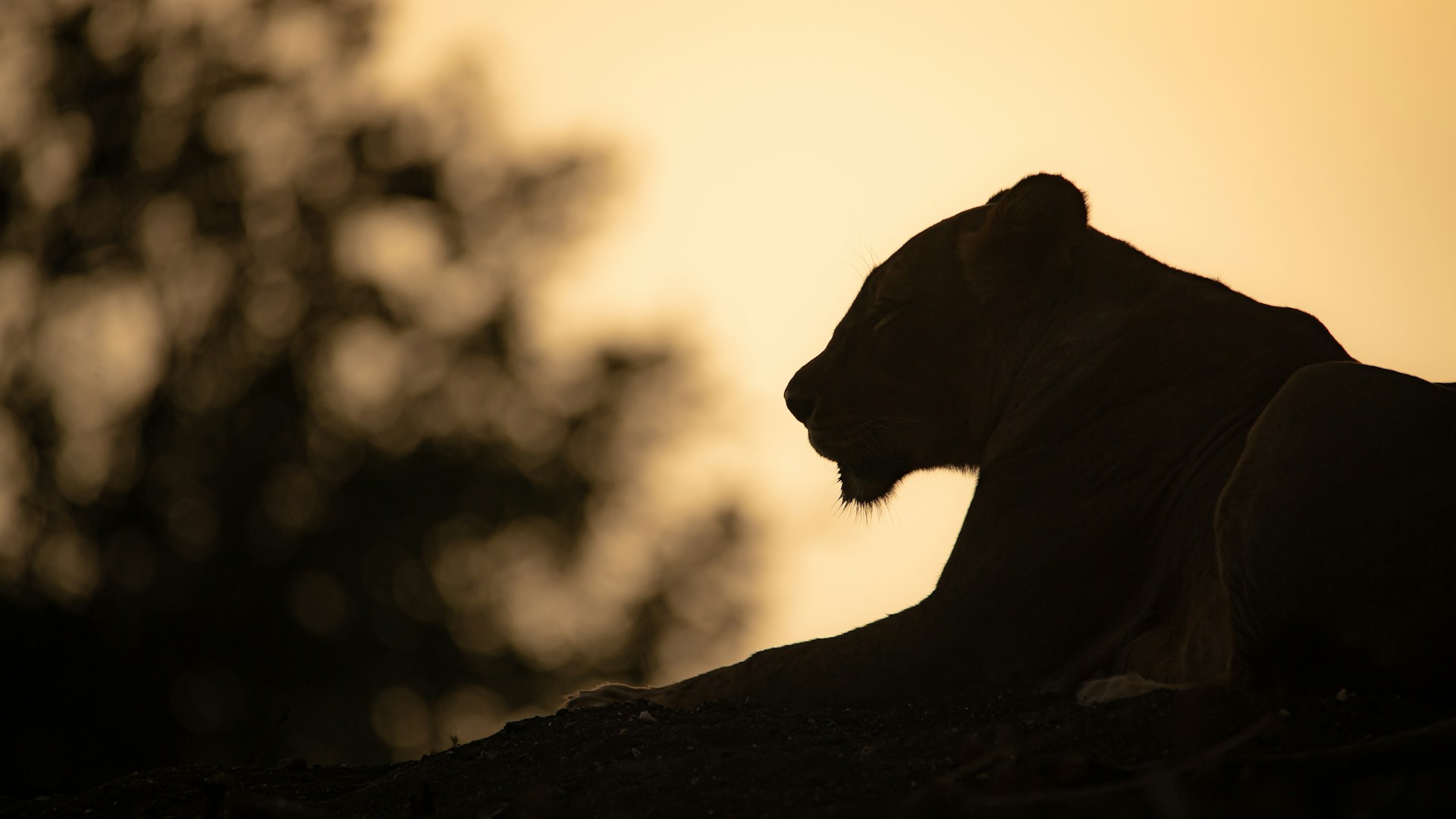
Do lions hunt at night?
Yes, and this is when they are at their most active and formidable.
Lions can sleep for up to 18 hours a day! This is probably why they often appear languid, sprawled in the golden grasses, lazing on one another (something they do to bond as a pride), and conserving their strength.
But the moment night falls, their character shifts and they become the savage, untamed animals they have a reputation for being.
In the coolness of twilight and night, they move in coordinated silence, their roars reverberating across kilometres of savannah, a territorial proclamation and a chilling reminder of their power.
You will never get tired or grow used to hearing a lion roaring. Every morning, just before the sun comes up and every evening, you’ll hear lions and the roar will stop you in your tracks and give you the shivers.
Lions’ eyes are also adapted for low light, giving them a sharp advantage over prey, while the darkness also gives the lion the upper hand, by helping them stay hidden.
To see a pride fan out beneath the stars, or hear the sudden cry of a zebra caught unaware, can leave you with mixed feelings.
While lions hunt exceptionally well at night, it is not at all uncommon to see them stalking prey during the daytime, as well as at dusk and dawn. Lionesses in particular will hunt during the day so that they can keep an eye on their young ones and perhaps even teach them a thing or two about the thrill of the chase.
Are honey badgers active at night?
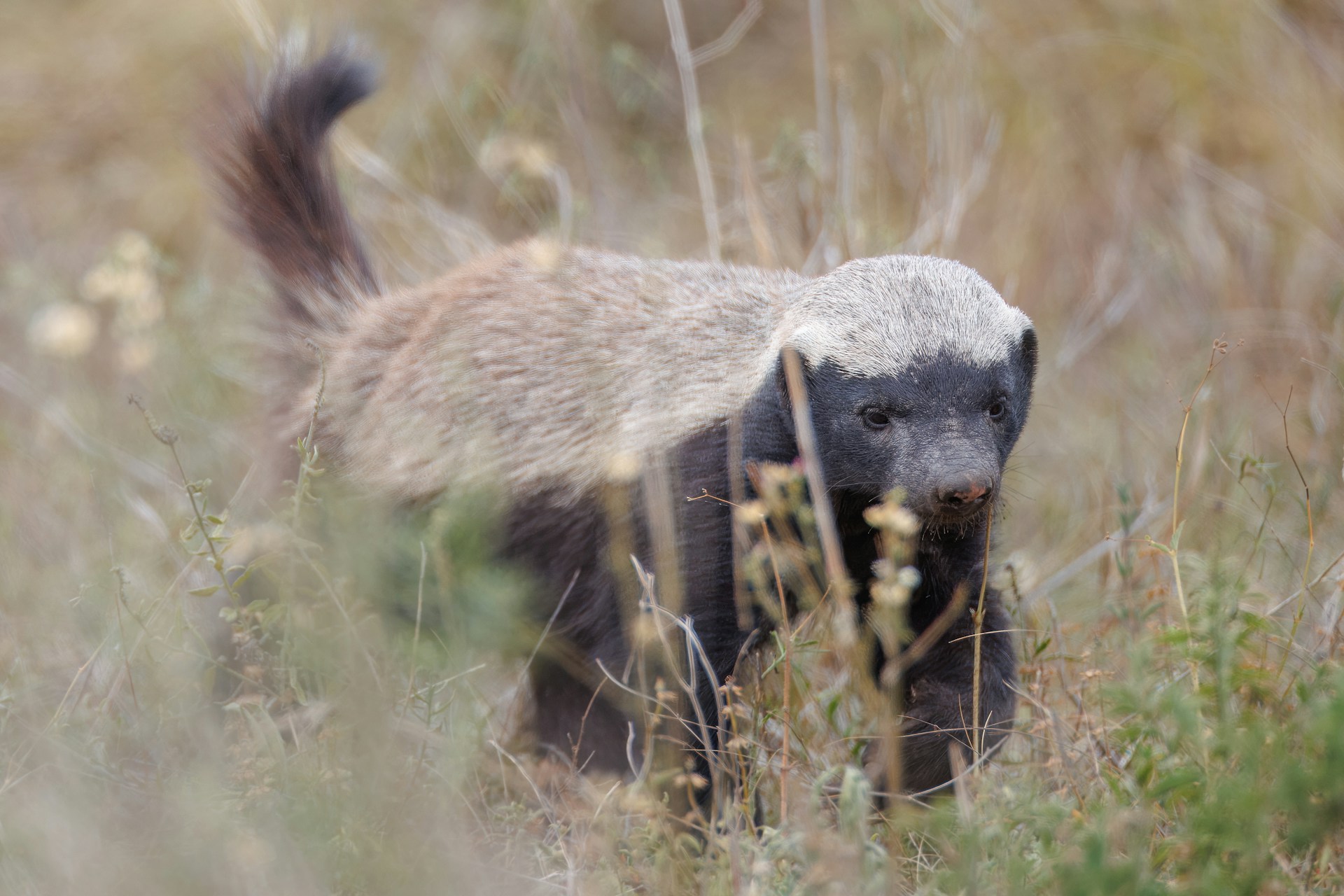
The honey badger has earned a reputation for being one of Africa’s most fearless animals, and rightly so.
These stout little creatures are largely nocturnal, scurrying across scrublands and woodlands under the safety of the cover of darkness, although they hardly need to be protected. Armed with sharp claws, a surprising turn of speed, and a really nasty attitude, honey badgers will raid beehives, dig out scorpions, and even challenge much larger predators.
But spotting one of these nocturnal animals in Africa on a night safari is a rare privilege. Honey badgers are solitary and secretive, often vanishing into burrows before you have time to blink.
Yet, while solitary, their audacity is legendary, and tales abound of honey badgers chasing lions from kills or refusing to back down when cornered.

Is it worth going on a night safari?
If your goal is to truly understand the character of Africa and its wildlife, the answer is simple: yes.
Day safaris may capture the majesty of elephants and wildebeest migrations, but they can only give you so many sightings before you start seeing more or less the same thing over and over again.
Night safaris peel back that curtain, exposing the secret lives of the nocturnal animals in Africa that you may never otherwise see.
The experience also changes you as a traveller.
Sitting in an open vehicle beneath a canopy of stars, you will become more tuned into your senses, and you’ll begin to notice a quieter side of the bush, like the chirp of crickets, the faint scent of the earth after a passing shower, or the sudden bark of a kudu warning of danger nearby.
If you are planning such a trip, keep in mind that often the only way to go on a night drive is to book it through the park you are visiting, rather than through the outfitter you are travelling with.
On a night drive, you’ll get to see a side of Africa that many travellers yearn to encounter, the Africa that is raw and authentic.
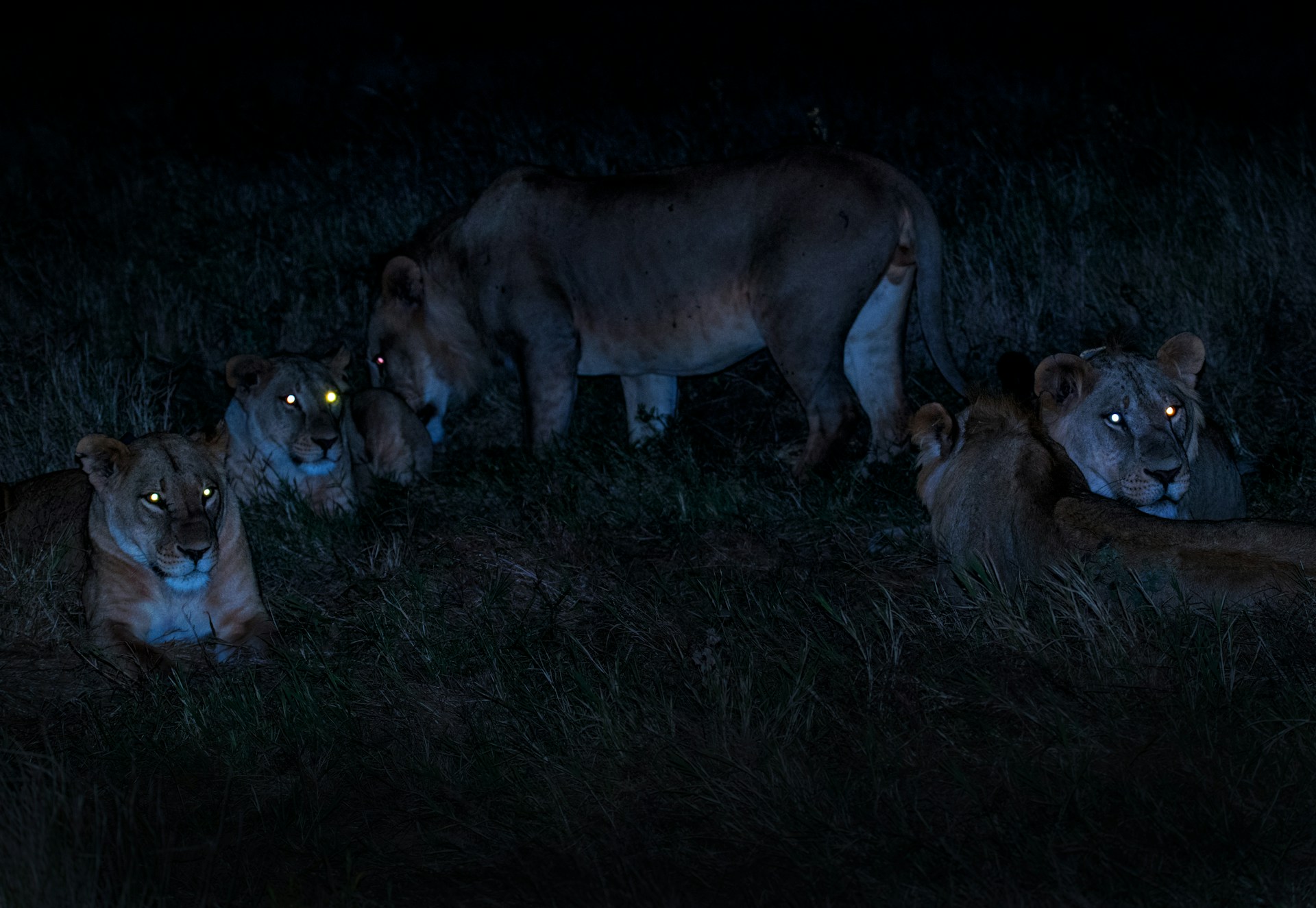
When the sun dips below the horizon, Africa does not fall asleep; it awakens.
If you’ve ever longed for more than just a holiday, for an experience that stirs the senses and leaves you changed, then a night safari to see the nocturnal animals in Africa is what you need.
Let the stars be your lantern and the night your guide.
Yes. Night drives are led by experienced rangers who know the terrain and the behaviour of nocturnal animals. Vehicles are designed for safety, and the use of red torches ensures minimal disturbance to wildlife while keeping the experience secure for guests.
In many parks, night drives can only be booked directly with the national park or private reserve you’re visiting, rather than through outside outfitters. You should always check with your lodge or safari guide when planning your itinerary.
It’s best to bring a warm jacket (the bush can get chilly after dark), binoculars, a good camera with low-light settings, and, of course, a sense of curiosity. Since parks provide lighting and guides, you won’t need to bring your own torch.
Red light is less disruptive to animals’ natural behaviour and is gentler on their sensitive eyes. It also reduces glare, allowing guides and travellers to spot nocturnal wildlife without startling them.
Some of the more frequently encountered species include bushbabies, civets, genets, porcupines, springhares, and owls. Predators like lions and leopards are also active after dark, making them a thrilling highlight of night drives.